
The system used in this game was simple: character sheets had 14 quest slots, so players were allowed to level up their characters every 14 games. The level-up process allowed you to raise one stat by one point:
| +1 Mind Point | Grants 4 extra Manna points. |
| +1 Body Point | Increases maximum Body Points by 1. |
| +1 Feat of Strength | Grants +1 Combat Die to attack. |
| +1 Feat of Dexterity | Grants +1 Combat Die in defense. |
Two characters have special leveling rules. The Druid, instead of leveling up normally, may opt to acquire a more powerful familiar or additional familiars — those rules can be found here. The rules for the Spectral Chaos Warlock can be found in the footnote at the bottom of the Warlock page.
This section written with help from Karnov & Dewayne Agin.
A Fate Point is awarded to a character for especially good roleplaying. They are given sparingly and used sparingly — a last resort, a stroke of luck saving throw.
Fate Points can be used in two different ways:
The GameMaster is often encouraged to come up with inventive explanations for each stroke of luck — and no explanation may be reused. An alternate rule: the player must come up with the explanation themselves. If they can't produce a new one, they can't use the Fate Point. These explanations tend to grow wilder and stranger as the quest continues.
Awarding Fate Points: They are not awarded lightly. They are given to players who help the GameMaster — suggesting an action the GM is clearly trying to steer toward, making an impassioned speech to persuade the party, or finding a new and inventive solution to a problem. Some GMs also award them for mundane contributions: typing up sheets, doing research, providing refreshments, or hosting. Occasionally they are given to characters who are especially weak in stats, as a way to help new players survive early encounters. Awarding a Fate Point is entirely at the GameMaster's discretion.
A Fate Point can also be used to help a new Hero joining an experienced group — the veteran Heroes have equipment and artifacts, the newcomer has none. Fate Points may allow them to acquire some gold and time to find their footing.
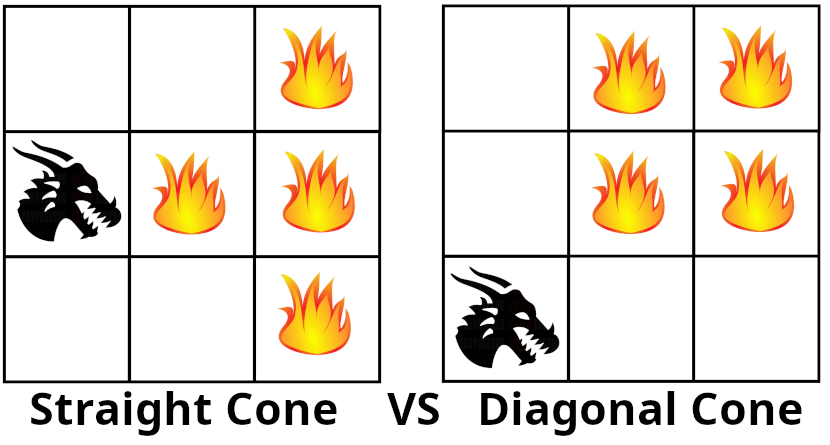
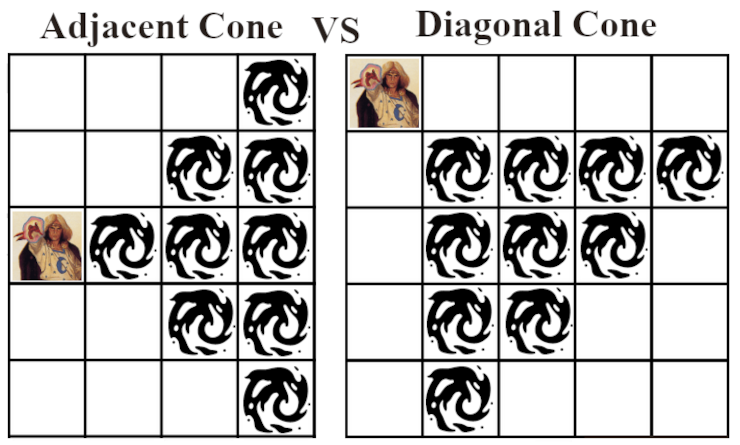
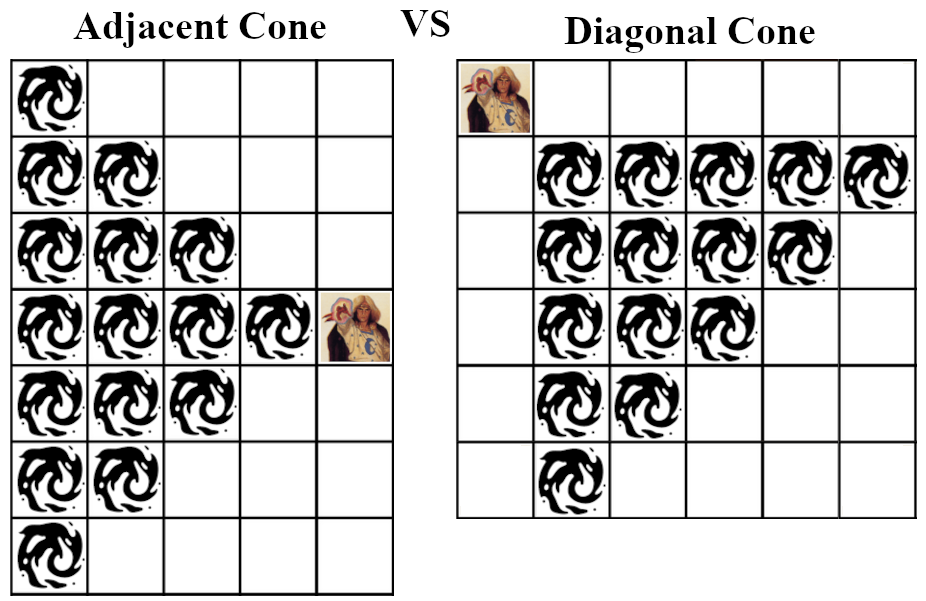
Certain spells and spell effects deal damage or create effects in cones. There are currently three cone sizes:
Hits 4 spaces total.
 Click to expand
Hits 9 adjacent · 10 diagonal spaces.
 Click to expand
Hits 16 adjacent · 15 diagonal spaces.
 Click to expand
If a Hero is affected by Lycanthropy Curse or injured by a Werewolf's attack, they become cursed to switch between Hero form and Wolf form. At the start of every turn, the Hero rolls 2D6:
When a Hero transforms into a Wolf, replace the figure with a Wolf tile or mini. All possessions are left in the square where the Hero transformed — place a Weapon Pack tile there to represent them. Monsters cannot take the Weapon Pack.
The Wolf is a true monster: no Hero abilities, moves on Zargon's turn, attacks as a Giant Wolf, is unaffected by traps or pits, and cannot open doors. At the end of Zargon's turn, the Wolf transforms back into the Hero and returns to the player's control.
The Hero must roll for transformation each turn until cured by drinking a Wolfsbane potion or the Potion of Restoration from the Alchemist's Shop.
Directly quoted from Karnov's page; originally from the DragonStrike rulebook by TSR, edited to fit HeroQuest.
Feats are a new type of Hero action, consolidating rules for jumping traps, disarming traps, picking locks, and knocking over monsters into a single mechanic. They are rolled on the Hero's turn unless stated otherwise. To succeed, roll a 20-sided die (1D20). If the result is equal to or less than the relevant Feat stat, the action succeeds.
Feat Limits
In dark maps, sight is limited — you cannot see to the end of a corridor, and you can only search what you can see. Monsters beyond your sight range are invisible. Spells and artifacts can counter darkness, but the simplest solutions are torches and lamps.
Both must be carried in a free hand — a Hero cannot carry a sword, shield, and torch simultaneously, and cannot carry a light source while wielding a two-handed weapon. A torch dropped on the floor must be picked up by the next turn or it goes out. A lamp may be set down safely, with a marker placed to show its position.
A torch can be thrown — roll a Combat Die: anything but a skull extinguishes it mid-flight. A lamp can also be thrown but is much more fragile and shatters on landing.
The threat of an occasional patrol adds pressure, keeps Heroes moving, and increases the dungeon's difficulty. Create a shuffled face-down pile of all monster cards behind the screen, then follow this sequence at the beginning of each of Zargon's turns:
More than one designated monster card can form a patrol, increasing patrol frequency and creating mixed groups. Additional cards may also act as proxies for the primary wandering monster type. Rules created by "Daedalus" from Old Scratch's HeroQuest Forum, posted by permission.
(1) The Feats section is quoted from Karnov's page, itself adapted from the DragonStrike rulebook by TSR, edited to fit HeroQuest.
(2) Wandering Monster Patrol rules created by "Daedalus" from Old Scratch's HeroQuest Forum. Rules posted by permission.